
You get one chance to choose your CalPERS payout option. It's irrevocable 30 days after your first check. And the official publications won't tell you which trade-offs matter for your household.
California state workers, school classified employees, and local government staff retire under one of the largest public pension systems in the country. CalPERS gives you seven payout options — the Unmodified Allowance plus Options 1, 2, 2W, 3, 3W, and 4 — and once 30 days pass from the date of your first retirement check, your election is permanent under California Government Code Section 21462. Not after a year. Not after a remarriage. For life.
The official CalPERS publications cover all of this. PUB 1, PUB 43, circulars, benefit education event slides — they cover every employer contract, every tier, every edge case. That's the problem. A PEPRA school classified employee opens PUB 1 and reads benefit formulas written for Classic state safety members. A local government worker can't tell whether their employer's contract includes sick leave conversion. A married couple trying to decide between the Unmodified Allowance and Option 2W finds the statutory definitions but not the question they actually need to answer.
The CalPERS Retirement Sequence — one member's path through the process, start to finish
This guide does what an official publication cannot: it follows one retirement from the first myCalPERS estimate through the first retirement warrant, in order, with the trade-offs for each decision explained side by side. Not every tier's rules and every employer's contract terms piled together. Yours.
What's inside
Your membership tier and benefit formula, identified
Classic members hired before January 1, 2013 and PEPRA members hired on or after that date operate under fundamentally different rules — different benefit formulas, different final compensation periods, different pensionable compensation caps. The guide walks you through confirming your tier on myCalPERS, understanding whether you use the single highest 12-month or the 36-month average final compensation, verifying your age factor, and checking your 2025 and 2026 PEPRA compensation limits before you run the numbers.
Reading your CalPERS estimate — the document that drives every decision
When you generate a Retirement Allowance Estimate on myCalPERS, you receive projected allowances under each payout option. The guide decodes the estimate section by section: what each line means, where to check the service credit total against your Annual Member Statement, and how to spot salary or age-factor discrepancies that silently drag your benefit down.
Service credit audit and purchases — the deadline that cannot move
Redeposits of withdrawn contributions, military service, service prior to membership — if you want the credit in your benefit calculation, every purchase must be formally requested and paid before your effective retirement date. The guide covers what's purchasable under current rules (airtime was eliminated by PEPRA), how to find gaps on your Annual Member Statement, and the strict statutory payment deadline that CalPERS will not extend.
The Service Retirement Election Application, section by section
PUB 43 is where the stakes get real: effective date selection within the 120-day filing window, payout option election, beneficiary designations, spousal or registered domestic partner signature witnessed by a CalPERS representative or notarized by a Notary Public, and tax withholding. The guide follows the application section by section, explains what each choice triggers downstream, and flags the errors that delay processing or cost you coverage.
All seven payout options compared — not listed, compared
The Unmodified Allowance pays the most per month but provides no ongoing lifetime survivor benefit after the member dies. Option 1 returns remaining accumulated contributions to your beneficiary as a lump sum. Options 2 and 2W give a 100% joint survivor benefit — 2 includes the pop-up provision that restores your full allowance if the beneficiary dies first, 2W waives it for a smaller monthly reduction. Options 3 and 3W do the same at 50%. Option 4 handles court-ordered community property divisions or lets you split your benefit by custom percentages among multiple beneficiaries. The guide lays out the trade-offs for each, including the actuarial reductions, the pop-up waiver mechanics under Government Code Section 21459, and the questions to bring to your CalPERS counselor before you sign.
Sick leave conversion — the formula, the eligibility, and the traps
CalPERS converts unused sick leave into service credit at the rate of 2,000 hours per year of credit — 8 hours equals 0.004 years. But conversion only happens if your employer's contract includes it and you retire within 120 days of separation. Vacation, annual leave, and compensatory time off do not convert. The guide walks through the calculation, shows how even a modest sick leave balance can shift your benefit, and explains the employer contract verification step most members skip.
PEMHCA health coverage — the 120-day rule that decides everything
Your retirement date must fall within 120 days of your separation from employment to preserve employer-subsidized retiree health coverage under the Public Employees' Medical and Hospital Care Act. Miss the window by one day and the coverage is permanently forfeited — not suspended, not reinstatable, gone. The guide walks through the separation-to-retirement timeline, vesting schedules, employer contribution levels, and the coordination steps with your HR department that keep the clock from running out.
Social Security after the WEP and GPO repeal
The Social Security Fairness Act, signed January 5, 2025, repealed both the Windfall Elimination Provision and the Government Pension Offset for benefits payable from January 2024. SSA paid retroactive adjustments starting February 2025. But confusion persists: members routinely conflate the repealed federal offsets with internal CalPERS plan-level coordination, which is a separate formula feature that still exists in some employer contracts. The guide explains the difference, how to verify SSA's adjustment, and what to do if you never applied because of the old offsets.
Post-retirement employment — the 960-hour cap and the 180-day wait
If you return to work at a CalPERS-covered employer as a retired annuitant, you cannot exceed 960 hours in a fiscal year (July 1 through June 30). PEPRA members face a mandatory 180-day wait period between retirement and re-hire. The guide covers the hour limits, the exceptions, and the consequences for your pension and health coverage if you cross the line.
Who this guide is for
- State miscellaneous and industrial employees within one to two years of retirement who need to confirm their tier, model their benefit, and prepare for the application
- School classified staff — instructional aides, custodians, administrative assistants, bus drivers — whose 10-month service year creates confusion around service credit accrual and final compensation
- Local government employees in contracting cities, counties, and special districts who need to verify their employer's specific contract terms with CalPERS before choosing a payout option
- Safety members — police officers, firefighters, correctional officers — navigating enhanced benefit formulas and non-Social Security status
- PEPRA members tired of reading Classic-era advice online and unsure how the compensation cap affects their allowance calculation
- Spouses and registered domestic partners involved in the payout-option decision who want to see the survivor income trade-offs in plain language
- Divorced members with a Qualified Domestic Relations Order who need to understand how community property claims are divided under Option 4
Why the free checklist isn't enough
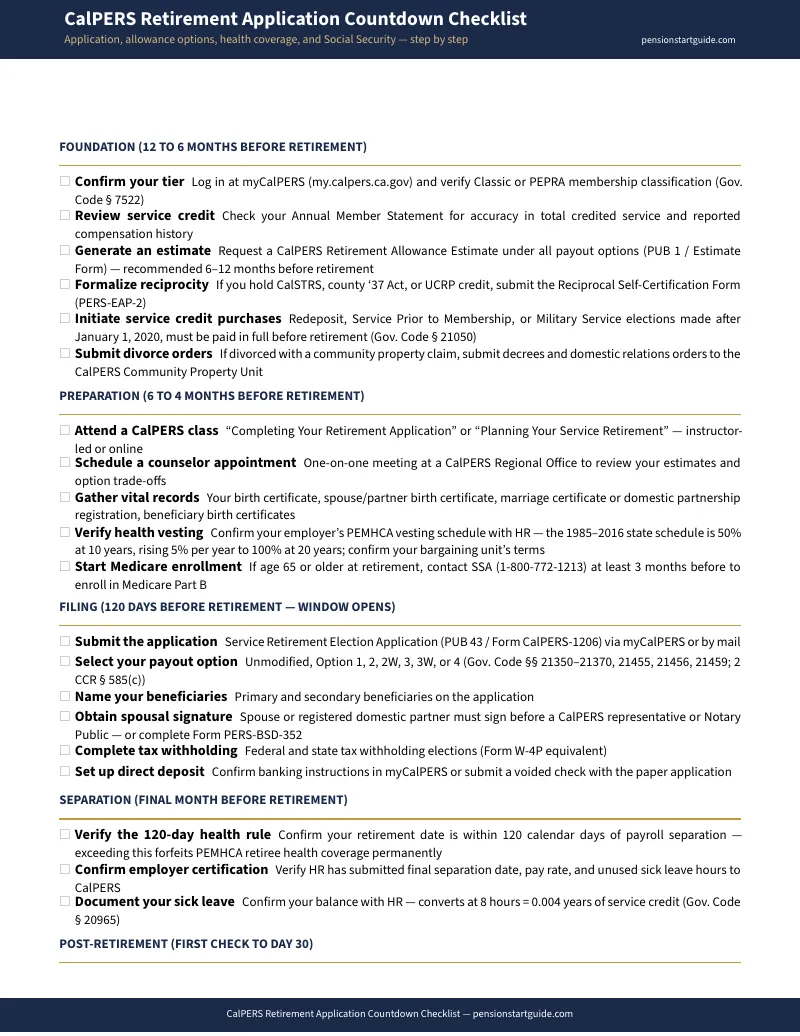
The free CalPERS Retirement Application Countdown Checklist gives you the steps in order — what to do 12 months out, 6 months out, 120 days before filing. It's a solid starting line. But the checklist tells you what to do. It doesn't tell you how to evaluate the trade-offs in each decision.
The difference between the Unmodified Allowance and Option 2W isn't a checklist item. It's a question about your spouse's independent income, your household's tolerance for a permanently reduced check, and whether the pop-up provision is worth the monthly cost. Whether your sick leave balance actually converts isn't a checklist item — it's a question about your employer's contract terms and the 120-day separation rule. The full kit puts those questions in front of you on the Allowance Option Comparison Worksheet, the Sick Leave Conversion Calculator, and the Health Coverage Separation Timeline — before you're sitting in myCalPERS with a submit button and no undo.
Full refund, no time limit
If the guide doesn't help you, email [email protected] for a full refund. No time limit. No forms. No questions.
The checklist is free — download it and start your timeline today. When you're ready to work through the payout-option trade-offs and the Service Retirement Election Application, the full guide is here.