
Your family member served North Carolina for decades. The claim paperwork arrived, and nobody at the state will tell you what to do with it.
When a TSERS member or retiree dies, the Retirement Systems Division sends forms. Not instructions — forms. The surviving family has to figure out whether the death triggers a lifetime monthly annuity, a one-time lump sum, or both. Whether the pension check for the month of death can legally be kept, and whether keeping the next one is a Class 1 Misdemeanor. Whether health insurance survives or ends in 30 days. Whether the beneficiary designation on file from 2003 still controls who gets paid.
The official handbook answers every question — for every member, in every situation, all at once. A surviving spouse trying to claim after a retiree's death reads rules written for the family of an active employee killed in the line of duty. An adult child managing the claim from out of state can't tell which form applies when two beneficiaries are named instead of one.
The TSERS Survivor Claim Sequence — one family's path through the process, start to finish
This guide does what the handbook cannot: it follows one survivor's claim from the first phone call to the final 1099-R, in order, with the consequences of each decision explained before you sign anything. Not every possible scenario. Yours.
What's inside
Immediate reporting and direct deposit rules
Who to call at RSD (919-814-4590), what information they need, and the Full Month Check Rule under N.C.G.S. § 135-5 — the estate can keep the check for the month of death, but every deposit after that must be returned. The guide explains how to handle the bank, the timeline, and the legal boundary.
Active-member and retiree death benefits, separated
The claim process splits in two depending on whether the member died while still working or after retirement. The guide covers both paths separately: the Survivor's Alternate Benefit, the Return of Contributions, and the Salary Death Benefit ($25,000–$50,000) for active-member deaths; the option continuance, the Guaranteed Refund, and the $10,000 Contributory Death Benefit for retiree deaths. No cross-referencing between sections, no guessing which rules apply.
The single-beneficiary rule — the trap that eliminates the lifetime annuity
The Survivor's Alternate Benefit pays a lifetime monthly annuity to the survivor of an active member who met the service or age threshold. But it only pays if exactly one living principal beneficiary is designated. If two adult children are named — or a spouse and a child — the annuity is legally disqualified and the payout drops to a one-time Return of Contributions split among the beneficiaries. The guide explains the rule, the fallback, and what families need to understand before the election deadline.
Every form mapped to its situation
Form 2C for active-member beneficiary claims. Form 336 for the retiree Guaranteed Refund. Form 333BEN for the Contributory Death Benefit. Form 290S for tax withholding elections. The employer's Form 253 for salary certification. The guide maps each form to the situation that requires it, lists the documents it needs, and explains what triggers a processing hold.
State Health Plan survivor coverage — three hire-date bands
Whether a surviving spouse keeps employer-paid health coverage, pays half the premium, pays the full premium, or gets nothing depends on when the member was first hired. The guide covers the three hire-date bands (before October 1, 2006; October 1, 2006 through December 31, 2020, with service-year sub-thresholds; and on or after January 1, 2021), the 30-day Benefitfocus enrollment window, and what happens if the retiree's service years fall between thresholds.
Four printable worksheets
The paid download includes fill-in PDFs the family can print: the Document Inventory Checklist, the Benefit Comparison Worksheet for the SAB versus lump-sum election, the Survivor Claim Tracker for every RSD / SHP / SSA call, and the Health Care Enrollment Tracker for the 30-day window.
Tax mechanics and IRA rollovers
Lump-sum payouts trigger mandatory 20% federal withholding unless rolled directly into a Traditional or Roth IRA. The guide walks through Form 290S withholding elections, explains the 1099-R distribution codes survivors receive, and covers the North Carolina Bailey Settlement exemption that may shield part of the benefit from state tax.
Social Security after the GPO repeal
The Social Security Fairness Act, signed January 5, 2025, repealed the Government Pension Offset for benefits payable from January 2024. Surviving spouses who were previously denied Social Security survivor benefits because of the GPO can now claim them in full. The guide explains the repeal, the retroactive adjustment process, and why TSERS Option 4 (Social Security Leveling) is an internal plan calculation that was never affected.
Who this guide is for
- Surviving spouses trying to determine whether the retiree's payment option provides a monthly continuance or whether all payments stop at death
- Adult children managing a parent's claim from out of state — coordinating RSD, the State Health Plan, and Social Security with limited time and a grieving family
- Named non-spouse beneficiaries who need to understand whether they qualify for the SAB annuity or will receive a lump-sum payout, and how tax withholding applies
- Executors and estate administrators ensuring pension funds are handled correctly, post-death deposits are returned, and the estate closes without liability
Why the free checklist isn't enough
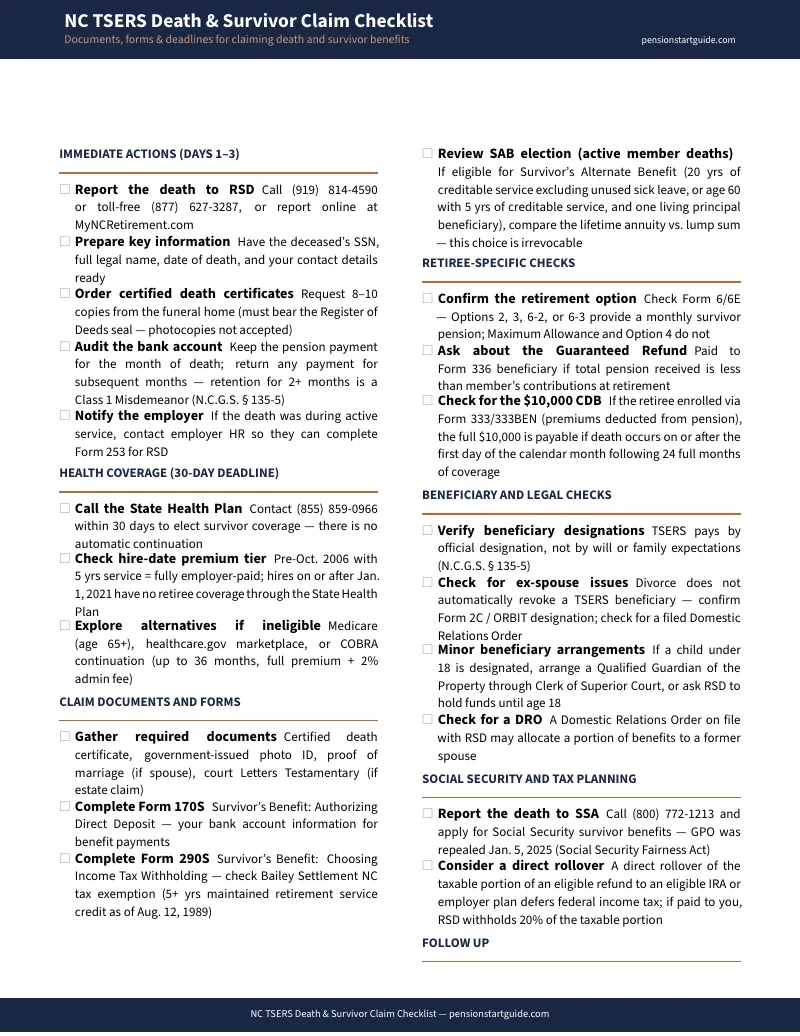
The free NC TSERS Death & Survivor Claim Checklist gives you the immediate steps: who to call, which documents to gather, and the 30-day health insurance deadline. It's the right place to start on day one.
But the checklist tells you what to do. It doesn't explain how to evaluate the choices you'll face. The difference between accepting the Survivor's Alternate Benefit and taking a lump-sum Return of Contributions isn't a checklist item — it's a decision about lifetime income versus a one-time payout, with tax consequences that depend on whether you roll the funds into an IRA or take direct payment. The full guide puts those decisions in front of you with the trade-offs explained before you complete the paperwork.
Full refund, no time limit
If the guide doesn't help your family, email [email protected] for a full refund. No time limit. No forms. No questions.
The checklist is free — download it and start your claim today. When you're ready to work through the benefit elections and tax decisions, the full guide is here.