You get one chance to choose your TRS annuity option. It's permanent the moment your first payment clears. And the official handbook won't tell you which trade-offs matter for your household.
Texas teachers, school staff, and college employees retire under one of the largest and most complex state pension systems in the country. TRS gives you a Standard Annuity plus five additional options — 100% Joint & Survivor, 50% Joint & Survivor, two Guaranteed Period options, and 75% Joint & Survivor — and once your first annuity payment is cashed or deposited, your election is permanent. Not after a year. Not after a divorce. Not ever, unless you return to TRS-covered employment and re-retire under new rules.
The official TRS Benefits Handbook covers all of this. It covers every membership tier, every exception, every formula. That's the problem. A Tier 5 teacher opens the handbook and reads Rule of 80 eligibility written for Tier 1 members who face no minimum age requirement. A support staff member at 27 years of service can't tell whether her sick leave credits push the timeline forward. A married couple trying to decide between the Standard Annuity and Option 1 finds the payout table but not the question they actually need to answer.
The TRS Retirement Sequence — one member's path through the process, start to finish
This guide does what a handbook cannot: it follows one retirement from the first Form TRS 18 estimate request through the first annuity deposit, in order, with the trade-offs for each decision explained side by side. Not every tier's rules piled together. Yours.
What's inside
Your membership tier and benefit formula, identified
Six membership tiers created by legislative changes in 2005, 2007, and 2014, each with different age floors, Rule of 80 thresholds, and salary averaging periods. The guide walks you through identifying your tier on MyTRS, understanding whether you use the highest 3 or highest 5 years of salary, and running the 2.3% accrual formula on your own numbers — before you trust someone else's math.
Reading the TRS estimate — the packet that drives every decision
When Form TRS 18 comes back, you receive an estimate packet showing your projected annuity under each option. The guide decodes the packet section by section: what each line means, where to check the service credit total against your own records, and how to spot salary discrepancies that silently drag your benefit down.
Service credit audit and purchases — the deadline that cannot move
Withdrawn service, military service, out-of-state service, unreported substitute teaching — if you want the credit in your benefit, every dollar must be paid before your effective retirement date. The guide covers what's purchasable, how to verify unreported service on MyTRS, and the strict statutory payment deadline that TRS will not extend.
Form TRS 30 application, line by line
The Application for Service Retirement is where the rubber meets the road: effective date selection, beneficiary designations, spousal signature, tax withholding elections. The guide follows the form field by field, explains what each choice triggers downstream, and flags the three most common errors that delay processing.
All five annuity options compared — not listed, compared
The Standard Annuity pays the most per month but stops the day you die. Option 1 continues your full check to a surviving beneficiary but permanently reduces what you both receive while you're alive. Option 5 splits the difference at 75%. Options 3 and 4 guarantee payments for a fixed period. The guide lays out the trade-offs for each, including the non-spouse age restrictions that limit Options 1 and 5, the pop-up provision that restores your benefit if your beneficiary dies first, and the questions to bring to your TRS counselor before you sign.
Partial Lump-Sum Option (PLSO) — the big-ticket decision inside the decision
Eligible retirees can take 12, 24, or 36 months of their Standard Annuity as a one-time lump sum via Form TRS 30P. The trade-off: every dollar you take up front permanently reduces your monthly check. The guide walks through the three PLSO tiers, the direct rollover rules that avoid mandatory 20% federal withholding, and the math framework that shows exactly how long the annuity reduction takes to eclipse the lump sum.
TRS-Care health insurance — the enrollment window that opens once
When you retire, you have 31 days to enroll in TRS-Care. Miss it, and your next open enrollment is when you turn 65 and become Medicare-eligible. The guide covers TRS-Care Standard and TRS-Care Medicare Advantage, premium structures, dependent coverage, and the rules for re-entry at 65.
Social Security after the WEP and GPO repeal
The Social Security Fairness Act, signed January 5, 2025, repealed both the Windfall Elimination Provision and the Government Pension Offset for benefits payable from January 2024. Most Texas K-12 ISDs don't participate in Social Security for TRS-covered service, so the practical impact depends on whether you have covered employment elsewhere. The guide explains how to check your coverage status using Form W-2 Box 3 or district payroll records, and how to provide TRS pension verification to SSA via Form TRS 562.
Return-to-work rules and the separation requirement
Go back to work at a TRS-covered employer before completing a full calendar month of separation, and TRS can retroactively void your retirement. The guide covers the one-month separation, half-time vs. full-time employment limits, and the surcharge your district pays if it rehires you.
Who this guide is for
- Texas classroom teachers and school staff within one to two years of retirement who need to confirm their tier, model their benefit, and prepare for the Form TRS 30 application
- ISD support staff — custodial, transportation, food service, administrative — whose non-standard work schedules create confusion around credited service and final salary certifications
- Higher education and community college employees who chose TRS over the Optional Retirement Program and need to understand how their coverage and Social Security status differ from K-12 colleagues
- Charter school employees with fragmented service credit who need to know what's purchasable and what the deadlines are
- Spouses and household partners involved in the annuity-option decision who want to see the survivor income trade-offs in plain language
Why the free checklist isn't enough
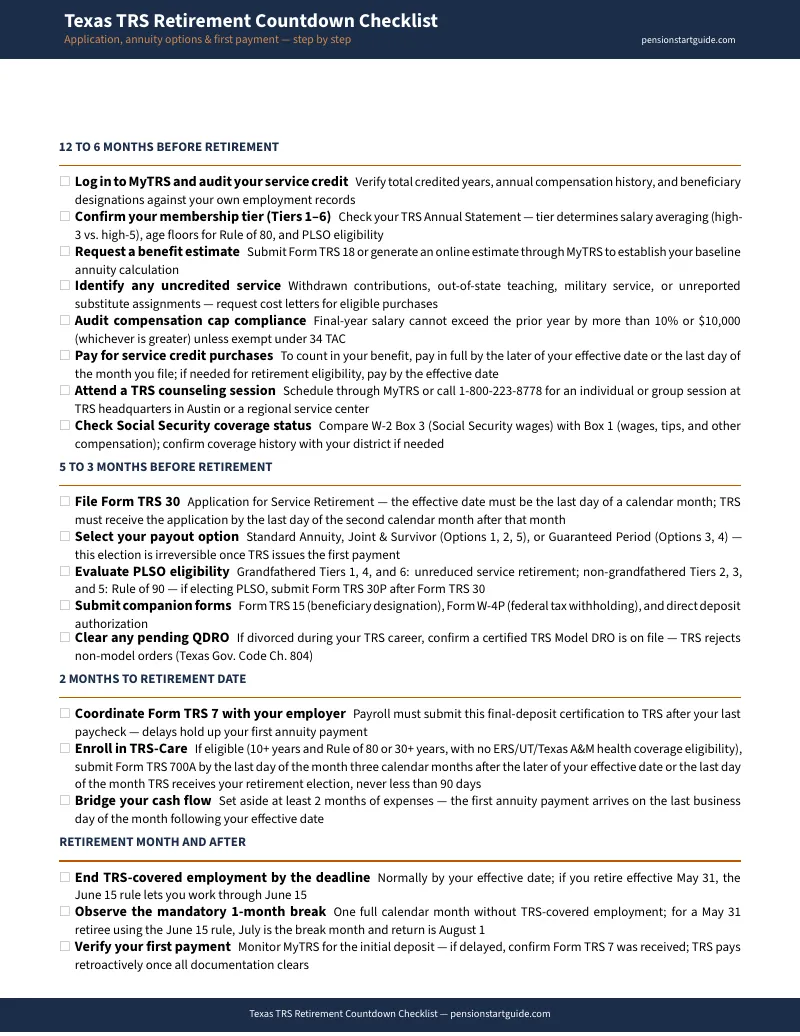
The free Texas TRS Retirement Countdown Checklist gives you the steps in order — what to do 12 months out, 6 months out, 90 days before filing. It's a solid starting line. But the checklist tells you what to do. It doesn't tell you how to evaluate the trade-offs in each decision.
The difference between the Standard Annuity and Option 1 isn't a checklist item. It's a question about your spouse's independent income, your household's tolerance for a permanently reduced check, and whether the pop-up provision is worth the monthly cost. Whether to take the PLSO isn't a checklist item — it's a question about your tax bracket, your rollover options, and how many years it takes for the annuity reduction to exceed the lump sum. The full guide puts those questions in front of you with the numbers side by side — before you're sitting in MyTRS with a submit button and no undo.
Full refund, no time limit
If the guide doesn't help you, email [email protected] for a full refund. No time limit. No forms. No questions.
The checklist is free — download it and start your timeline today. When you're ready to work through the annuity-option trade-offs and the Form TRS 30 application, the full guide is here.