Your TRS payout plan election becomes permanent the moment your first check is deposited. TRS counselors are legally prohibited from recommending one. And the Member's Guide won't tell you which trade-offs matter for your household.
Georgia educators retire under a defined benefit formula that is straightforward on paper — 2% × Years of Service × Final Average Salary ÷ 12 — and deeply complex in practice. TRS gives you seven payout plans: Plan A (Maximum Plan), Plan B Options 1 through 4, and the Pop-Up variants that restore your full benefit if the beneficiary dies first. You can layer on a Partial Lump-Sum Option Plan (PLOP) that pays you 12, 24, or 36 months of your Maximum benefit up front in exchange for a permanently reduced monthly check. And once TRS processes your first pension payment, every one of those elections is irrevocable under Georgia law.
The official TRS Member's Guide covers all of this. It also covers PSERS staff who aren't in your system, disability retirements you aren't filing, and death-in-service survivor claims you don't need. A 30-year classroom teacher planning a July retirement reads the same 112-page statutory reference as a career-switcher evaluating an early-reduced option. A married couple trying to decide between Plan A and Plan B Option 2 Pop-Up finds the legal definitions but not the side-by-side comparison they actually need.
The Georgia TRS Retirement Sequence — one member's path from first estimate to first check
This guide does what an official handbook cannot: it follows a single retirement from the first MyTRS benefit estimate through the first pension payment, in order, with the trade-offs for each decision explained side by side. Not every scenario for every member class in one document. Yours.
What's inside
Your benefit formula, calculated
The 2% factor is simple. What isn't simple is verifying your Final Average Salary across the two highest consecutive years, understanding the post-1984 salary-increase cap that can quietly exclude compensation earned above the allowable ceiling, checking the IRS § 401(a)(17) limit on pensionable earnings, and confirming whether your creditable service total on MyTRS includes every year it should. The guide walks through each component of the formula with worked examples — including the 40-year service cap that means years 41 and beyond add nothing to your benefit.
The sick leave audit — service credit you already own
TRS converts unused sick leave into creditable service at the rate of one month of credit for every 20 days of certified unused sick leave. The minimum is 60 days — anything below that converts to nothing. And here is where most members get caught: TRS caps the accrual rate at 1.25 days per month of service, regardless of what your district actually granted. If your school system accrued sick leave at 1.5 or 2 days per month, TRS will scale back your balance during the final audit. Worse, if you participated in a local attendance incentive program that paid cash bonuses for unused sick days, those days are permanently disqualified from TRS service credit. The guide walks you through auditing your balance before TRS does.
All seven payout plans compared — not listed, compared
Plan A pays the highest monthly benefit and stops the day you die. Plan B Option 1 guarantees that your accumulated contributions are refunded to your beneficiary if you die before exhausting them. Options 2, 2 Pop-Up, 3, 3 Pop-Up, and 4 provide lifetime survivor benefits to your designated beneficiary at a permanent actuarial reduction to your monthly check. The Pop-Up variants restore your benefit to the Plan A level if your beneficiary predeceases you. Option 4 lets you name multiple beneficiaries at custom percentage splits. The guide lays out the trade-offs for each plan — including the IRS MDIB rule that caps the survivor percentage when you name a non-spouse beneficiary more than 10 years younger than you, and the fact that multiple-beneficiary percentage allocations are permanently fixed even if one beneficiary predeceases you.
The Partial Lump-Sum Option Plan (PLOP) — taking cash up front
If you qualify for normal unreduced retirement (30 years at any age, or age 60 with 10+ years), you can elect a PLOP distribution equal to 12, 24, or 36 months of your Maximum Plan benefit. The trade-off: your monthly pension check is permanently reduced based on your age at retirement and the PLOP amount. The guide explains the eligibility criteria, the actuarial reduction math, and the tax mechanics — direct rollover into a traditional IRA or 403(b) versus a direct cash payment with 20% mandatory federal withholding plus Georgia state tax.
Social Security after the 2025 WEP/GPO repeal
On January 5, 2025, the Social Security Fairness Act repealed the Windfall Elimination Provision and the Government Pension Offset for benefits payable from January 2024 onward. Most Georgia school districts participate in Social Security alongside TRS. But several — most notably Gwinnett County Public Schools, which withdrew from Social Security in 1983 and established the Gwinnett Retirement System — do not. The guide explains how to verify your district's Social Security coverage history, check your earnings record on ssa.gov, and determine whether SSA owes you a retroactive adjustment. It also addresses why union blogs and financial advisor articles still warn about WEP and GPO as though they are active law.
State Health Benefit Plan — a separate system with its own deadlines
TRS handles your pension. SHBP handles your health insurance. They are different agencies with different portals and different rules. To continue health coverage as a retiree, you must have had continuous active SHBP enrollment immediately before retirement — a gap disqualifies you. When you or a covered spouse reaches age 65, you must enroll in Medicare Part B and then an SHBP-sponsored Medicare Advantage plan. Miss the strict 31-day Qualifying Event window around your 65th birthday and you lose the state subsidy. The guide walks through the enrollment timeline for both pre-65 and post-65 retirees.
The MyTRS application — filing step by step
TRS accepts applications up to 6 months before the effective retirement date, and effective dates must fall on the first day of a calendar month following employment termination. Submit late — fewer than 30 days before the effective date — and TRS cannot process your first check on time. The guide covers the digital submission through the MyTRS portal section by section: effective date selection, beneficiary designations, spousal notarizations, direct deposit authorization, and federal (W-4P) and Georgia (G-4P) tax withholding forms.
Return-to-work rules — what Georgia law allows and what it doesn't
If you plan to work part-time for a TRS-covered employer after retirement, you must observe a mandatory one-calendar-month break in service. After that break, you are limited to 49% of the employer's full-time work schedule and the annual Schedule of Maximum Hours set by the TRS Board (992 hours for FY2026/FY2027). Work even one paid hour during the month of your effective retirement, and Georgia law (O.C.G.A. § 47-3-127) requires you to reimburse every dollar of pension benefits paid. The guide covers the rules, the reporting requirements, and the pre-approval steps that keep you in compliance.
Who this guide is for
- K–12 classroom teachers, principals, and district staff within one to two years of retirement who need their retirement steps in one place, in order
- University System of Georgia faculty and administrators whose academic-year contracts create confusion around service credit accrual and FAS
- TCSG instructors and staff integrating a 403(b) or 457(b) supplement with their TRS pension
- Members with 25–29 years of service evaluating whether the permanent early retirement penalty or a service credit purchase is the better path
- Spouses involved in the Plan A vs. Plan B decision who want to see the survivor trade-offs in plain language before signing the consent form
- Members with a prior divorce decree that references the TRS pension and need to understand how domestic relations orders interact with plan elections
- Adult children helping a parent assemble the paperwork and avoid irreversible filing errors
Why the free checklist isn't enough
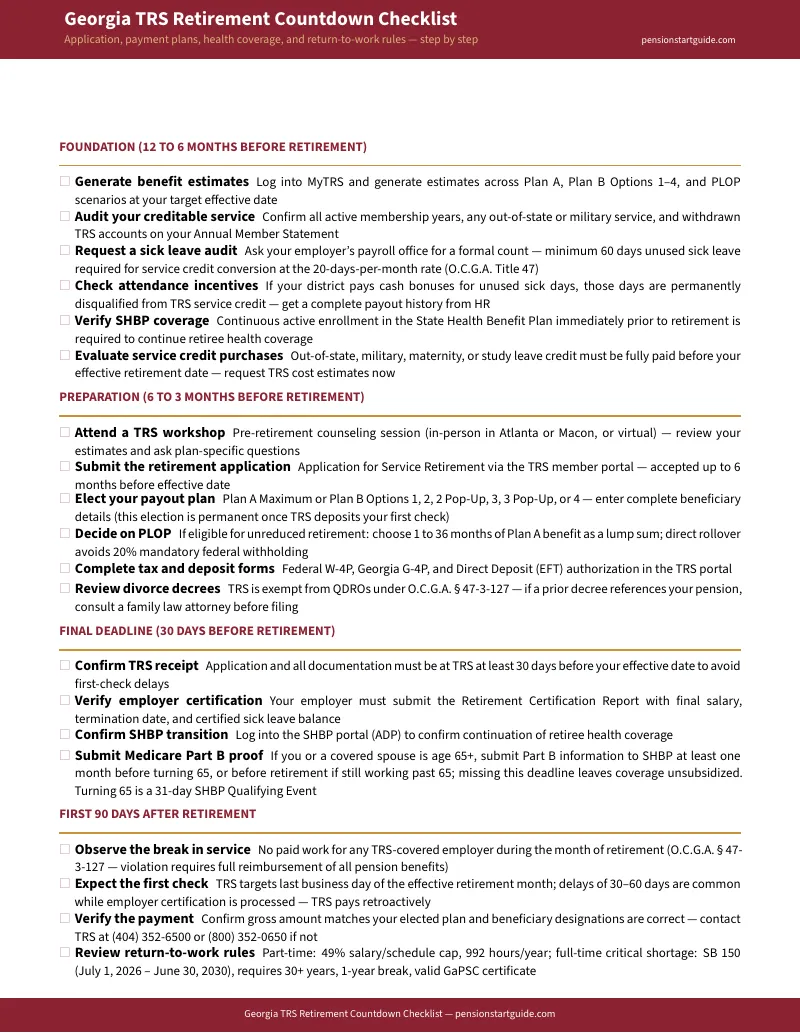
The free Georgia TRS Retirement Countdown Checklist gives you the steps in order — what to do 12 months out, 6 months out, 30 days before your retirement date. It's a solid starting line. But the checklist tells you what to do. It doesn't tell you how to evaluate the trade-offs in each decision.
The difference between Plan A Maximum and Plan B Option 2 Pop-Up isn't a checklist item. It's a question about your spouse's independent income, your household's tolerance for a permanently reduced check, and whether the bounce-back provision justifies the monthly cost. Whether your sick leave balance will survive the TRS audit isn't a checklist item — it's a question about your district's accrual rate, your attendance incentive history, and the statutory 1.25-day cap. The full guide puts those questions in front of you with the Benefit Option Comparison Worksheet and the Sick Leave Audit Tracker — before you're sitting in MyTRS with a submit button and no undo.
Full refund, no time limit
If the guide doesn't help you, email [email protected] for a full refund. No time limit. No forms. No questions.
The checklist is free — download it and start your timeline today. When you're ready to work through the payout-plan trade-offs and the retirement application, the full guide is here.