Your FRS Retirement Hinges on Five Decisions You Cannot Undo
You have spent decades teaching, protecting, or serving Florida's communities. Now the Division of Retirement hands you a stack of forms and asks you to make choices that will determine your monthly income for the rest of your life — and your spouse's income after you die. Option 1, 2, 3, or 4. DROP or no DROP. Pension Plan or Investment Plan. Each choice is irrevocable once your first check is cashed or your DROP begins.
The official handbook is 130 pages of legalese written for every membership class at once. Your HR office is fielding the same questions from fifty other people this month. The MyFRS Financial Guidance Line runs excellent projections — but nobody there will tell you which forms to file, in what order, or what happens if you miss the 30-day post-termination window.
The FRS Retirement Execution Roadmap
This is not a financial plan. It is a step-by-step procedural guide that puts your retirement application, your payout-option decision, your DROP entry, your terminal leave coordination, and your first pension check into one ordered sequence — with the trade-offs explained at every decision point so you can make each call with your eyes open.
The guide is built on the current statutory framework: Chapter 121 of the Florida Statutes, SB 7024's expanded DROP provisions, the post-January 2025 WEP/GPO repeal, and every official form published by the Division of Retirement and MyFRS. It is independent. It does not sell investments, manage assets, or recommend a payout option.
What the Guide Covers
- Tier I vs. Tier II identification — Your enrollment date determines everything: 6-year vs. 8-year vesting, AFC-5 vs. AFC-8, and vastly different normal retirement ages. The guide confirms which rules apply to you before you touch a single form.
- Pension formula with worked examples — Years of service × percentage value × Average Final Compensation, calculated step by step for Regular Class and Special Risk members, so you can verify the estimate the Division sends you.
- Options 1 through 4, side by side — Option 1 pays the maximum check but leaves your spouse with nothing ongoing. Option 3 guarantees a lifetime survivor annuity but reduces your monthly payment by 10% to 20%. The guide explains the actuarial math behind each reduction, shows what each option means at different ages, and lists the questions to bring to your MyFRS planner — without telling you which one to pick.
- Form SA-1 spousal consent workflow — If you select Option 1 or Option 2 while married, your spouse must sign Form SA-1 before a notary public acknowledging the loss of survivor annuity rights. The guide walks through the conversation, the document preparation, and the notarization steps — because a refused signature stalls your entire application.
- DROP under SB 7024 — The old 60-month cap and 1.3% interest rate are gone. The guide covers the current 96-month window (120 months for K-12 instructional personnel), 4.0% interest compounded monthly, the elimination of the 12-month entry restriction, and the distribution choices when DROP terminates. If your advisor or union newsletter is still citing the old rules, they are working from pre-2023 information.
- Investment Plan distributions — Lump sum, IRA rollover, systematic withdrawals, or private annuity purchase — plus the Second Election mechanics for members who want to switch plans before separating.
- Service credit purchases — Military service, out-of-state public service, refunded prior FRS service. The Division charges 6% annual interest every June 30, and the balance must be paid in full before your effective retirement date. The guide maps the timeline so the interest doesn't compound into an unpleasant surprise.
- BENCOR terminal leave tax sheltering — How Florida school districts use 401(a)/403(b)/457(b) Special Pay Plans to shelter your accrued sick and vacation leave from 7.65% in FICA and Medicare taxes — and where that process intersects with your FRS application timeline.
- Health Insurance Subsidy — The updated $7.50 per month per year of service rate, the $45 minimum and $225 monthly maximum, Form HIS-1 filing after your first pension check, and the proof-of-coverage documentation the Division requires. The old $5.00 rate and $150 cap are still cited across dozens of advisor websites.
- Reemployment rules — Six calendar months of complete termination from every FRS-covered employer. Part-time, OPS, adjunct, third-party contracting — any of it during months 1 through 6 voids your retirement entirely, and you and the employer become jointly liable to repay every check and every DROP payout. The guide covers the rule, the exceptions, and the month-7-through-12 restrictions.
- Social Security after the WEP/GPO repeal — The Social Security Fairness Act repealed both offsets for benefits payable from January 2024 onward. Most FRS positions are FICA-covered, so WEP/GPO rarely applied to standard FRS pensions in the first place. The guide clarifies the rules for members with non-covered outside service and explains how to verify SSA's retroactive adjustment.
Who This Is For
- Florida teachers and school board employees one to two years from retirement or DROP entry, including those navigating BENCOR terminal leave payouts
- State agency employees filing Form FR-11 for the first time, who need the application sequence in order
- Special Risk members — law enforcement, fire, corrections, EMTs — with higher accrual formulas and the restored Tier II age-55/25-year threshold
- Investment Plan members evaluating the one-time Second Election before separating
- Spouses trying to understand Option 1 vs. Option 3 before signing Form SA-1
- Adult children helping a parent avoid the filing deadline, the reemployment trap, or a stale advisor's outdated DROP numbers
Why Free Resources Fall Short
The Division of Retirement publishes every form and every rule. MyFRS offers free EY financial planners. Your union runs pre-retirement seminars. None of these sources provide a unified, step-by-step execution sequence that connects your tier verification to your option selection to your SA-1 notarization to your BENCOR coordination to your Form FR-11 submission to your first check — in the order things actually need to happen, with only the rules that apply to your membership class.
And none of them are updated for the post-SB 7024 DROP rules or the post-January 2025 WEP/GPO repeal. Private advisor websites are the worst offenders — many are still citing the 60-month DROP cap, the 1.3% interest rate, and WEP/GPO as active offsets, because their pages were written before the law changed and never corrected.
Satisfaction Guarantee
If the guide does not give you the clarity you need, email [email protected] for a full refund, no time limit. No forms, no questions, no hoops.
Get Started
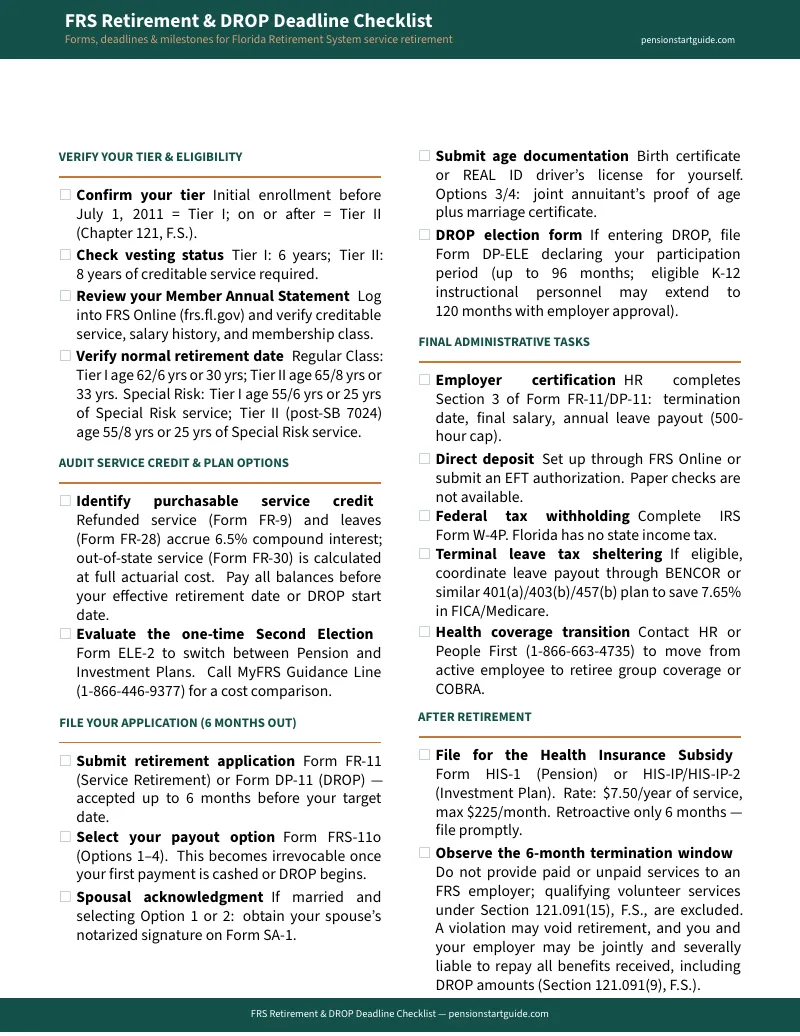
Download the free FRS Retirement & DROP Deadline Checklist to see the timeline, the forms, and the reemployment rules at a glance. When you are ready to work through every decision point with the full execution roadmap, the complete kit is — a one-time purchase, not a subscription. It includes the 45-page guide, the countdown checklist, and 7 standalone printable worksheets covering the pension formula, option comparison, application tracking, service credit purchases, reemployment compliance, DROP distribution, and the Health Insurance Subsidy.